
Money
Should you refinance your home loan? Here's how to decide

If you haven't reviewed your home loan in the past year, refinancing could help you secure a lower interest rate, reduce your monthly repayments and potentially save thousands over the life of your loan.
By Citro
Most of us compare insurance, energy providers and phone plans to make sure we're getting good value. But when it comes to our mortgage, it's easy to set it and forget it.
If you've had your home loan for several years, it's worth asking one important question: is it still the best option for your circumstances?
Life changes, interest rates rise and fall, and new loan products enter the market. But your mortgage often keeps ticking along in the background. If your home loan hasn't kept pace with what's available today, you could be paying more than you need to.
When should you consider refinancing?
There's no hard and fast rule, but reviewing your home loan every 12 months is a smart habit. Even if you're not planning to switch lenders, checking whether your mortgage is still competitive can help you avoid paying more than necessary. It may be time to explore your refinancing options if:
- your interest rate is higher than current market rates
- your fixed-rate period is coming to an end
- you've built up more equity in your home
- your financial situation has improved
- you want features such as an offset account or more flexible repayments
- you're looking to lower your monthly repayments or pay off your loan sooner.
Even if you're happy with your current lender, comparing what's available can help you decide whether it's still offering competitive value. When comparing options, it’s also worth looking beyond the headline rate to features that can help you get ahead, such as flexible repayments, offset accounts and useful digital tools that make managing your mortgage easier.
One of the easiest ways to compare home loans is by searching online or using mortgage comparison websites. These platforms let you compare interest rates, fees and loan features side by side at no cost. Most comparison websites are funded by referral fees paid by lenders, rather than by borrowers. Keep in mind that comparison sites don't always include every lender, so it's worth checking a few different websites to get a more complete picture of what's available.
It can also help to compare how easy different lenders make the refinance process itself, including the tools and support available once you switch.
Is refinancing difficult?
Many homeowners put off refinancing because they assume it involves endless paperwork and a complicated approval process.
In reality, refinancing is often much simpler than people expect. Many lenders now offer online applications, digital document verification and dedicated support to help guide you through the process from start to finish.
Before making the switch, compare more than just the advertised interest rate. Consider any refinancing costs, ongoing fees, loan features and whether the new loan will genuinely save you money over the long term.
How much could a lower rate really save?
Even a relatively small difference in interest rates can have a significant impact over the life of your loan.
Here's how the numbers compare for a $700,000 owner-occupied principal-and-interest home loan over 25 years:
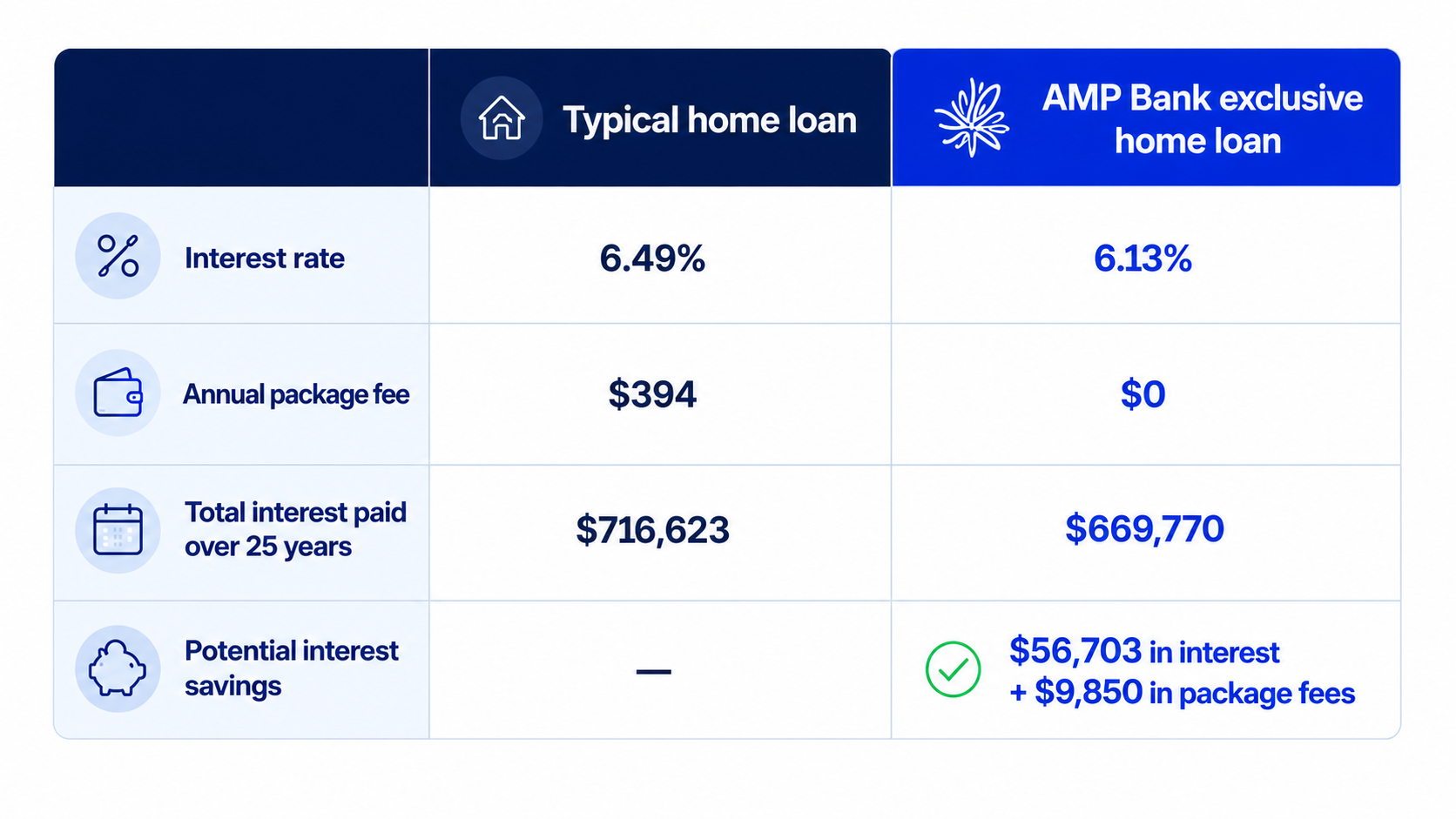
If you could reduce your interest rate by just 36 basis points, from 6.49% to 6.13% – such as with AMP Bank's exclusive home loan – your total interest over a 25-year loan could fall to $669,770, with no annual package fee. That's $56,703 in interest staying in your pocket instead of going to your lender. If you're paying a higher rate without reviewing your options, you could be paying more than you need to.
The figures above show how even a small reduction in your interest rate can deliver substantial long-term savings and lower ongoing repayments.
Why your lender may not automatically lower your rate
Many borrowers assume that if better rates become available, their lender will pass them on automatically.
In reality, lenders often introduce new products or promotional rates aimed at attracting new customers. Existing borrowers may remain on older loan products unless they ask for a review or choose to refinance.
That doesn't necessarily mean you should switch lenders every time rates change. But it does mean it's worth checking whether your current loan is still competitive.
Benefits of refinancing: it isn't just about saving money
Saving money is often the biggest reason people refinance, but it's not the only one. Depending on your circumstances, refinancing may help you:
- reduce your monthly repayments
- access features such as an offset account
- consolidate debt
- make extra repayments more easily
- manage your loan through improved digital tools.
The right loan is one that supports your financial goals, not simply the one with the lowest advertised rate.

Want to maximise the savings?
If your budget allows, consider keeping your repayments the same after refinancing instead of reducing them.
In our example, refinancing lowers the minimum monthly repayment on a $700,000 loan from $4,722 to $4,566. Rather than pocketing the $189 difference each month, you continue paying the original amount and put the difference straight towards reducing your loan balance.
The long-term impact can be significant. Your total interest bill falls even further, dropping from $669,770 to around $601,289. That's an additional $68,481 in interest savings on top of what refinancing already delivered, and you could pay off your mortgage almost five years sooner.
Compared with the original loan at 6.49%, where total interest was $716,623, the savings become even more compelling. Sometimes the smartest refinance strategy isn't spending the savings — it's using them to become mortgage-free sooner.
So, should you refinance?
If you haven't reviewed your mortgage in the past year, the answer is simple: it's worth finding out whether refinancing could benefit you.
Whether you decide to stay with your current lender or switch to another, regularly reviewing your home loan could be one of the simplest ways to strengthen your financial future.
Tools such as AMP Bank's Rapid Repay calculator can also help you understand how lower rates or additional repayments could reduce your interest costs and shorten your loan term.
Whether you decide to stay with your current lender or switch to another, regularly reviewing your mortgage could be one of the simplest ways to strengthen your financial future.
Feature image: Canva/JohnnyGreig from Getty Images Signature
Credit provider and product issuer AMP Bank Limited AFSL/Australian Credit Licence 234517. This article contains general information only. It is not financial advice and is not intended to influence readers’ decisions about any financial products or investments. Readers’ personal circumstances have not been taken into account and they should always seek their own professional financial and taxation advice that takes into account their financial circumstances, objectives and needs.
More help for your home loan: