
Lifestyle
Kicking goals at 50: How Amanda found her soccer family
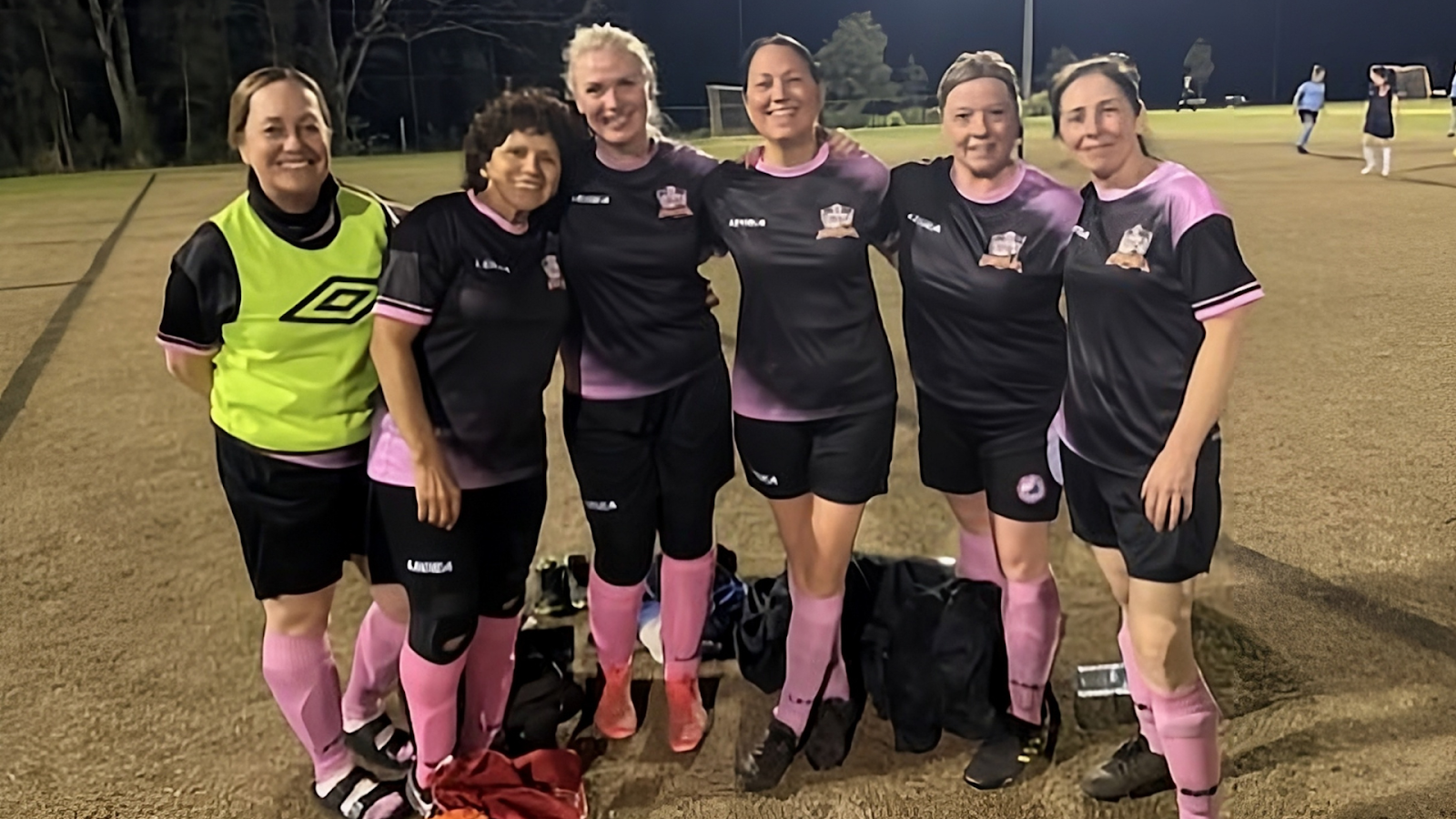
Joining a women’s soccer team in her 40s gave Dr Amanda Mullin (third from left) a second sporting life.
As told to Elli Jacobs
I grew up in Scotland at a time when sport simply wasn’t a priority, especially not for girls.
I remember being on the school swim team and feeling the quiet pressure to quit. Not because I didn’t love it, but because it meant wet hair, missed social time and the subtle discomfort of standing apart from my friends.
When it comes to football, I don’t remember it ever being presented as an option for me as a teenage girl. I’d played as a child, everyone did, but by adolescence it all quietly slipped away. No invitation, no encouragement, no visible pathway. It wasn’t explicitly forbidden; it just wasn’t there. The unspoken message was clear: sport wasn’t “cool” for girls. Sport belonged to boys.
Challenging unhelpful beliefs
By the time I moved to Australia, in 2003, I had two young children and was building a busy psychology practice. I was stretched thin in every direction.
A few years earlier, I’d encouraged my husband to take up football again. I could see how stressed he was, how much he needed something that belonged solely to him. It never occurred to me that I might need the same.
At that point, my relationship with movement was largely solitary. I was a runner. I loved being fit – doing 5K and 10K runs, entering fun runs where you’re surrounded by people but still fundamentally alone. I went to the gym. Exercise was about discipline, health, ticking a box.
Then a friend asked if I wanted to join a local women’s soccer team in Sydney’s Hills District competition – pure grassroots sport, in 2012. They trained once a week and played on the weekends.
What went through my mind surprised me. My first fear wasn’t about fitness or skill – it was how my legs would look. I remember thinking I’d look terrible in shorts, that everyone would stare, that I’d be judged.
Then another part of me surfaced: the psychologist in me, who recognised those thoughts instantly for what they were. I realised that if I truly believed in challenging unhelpful beliefs, I had to be willing to challenge my own. So, I said yes and decided to do it anyway.
The moment I stepped onto the field
Walking onto the field for that first training session, I was nervous. I hadn’t kicked a ball properly since I was a child. I was relieved that I’d been running and had some fitness behind me, but mostly I felt exposed.
I started in defence. “The easiest place,” the coach said, where I could see the ball coming. Then I moved to the wings, along the sidelines.
What surprised me was how quickly I fell in love with it. I loved the structure, the learning, the laughter, the simple act of showing up week after week.
But alongside that joy came fear. My biggest worry was letting the team down. I had to make peace with the idea that someone is always the worst player on the field, and that it was okay if that someone was me.
That acceptance changed everything. Learning to be bad at something, to do it for joy rather than achievement, turned out to be one of the most liberating lessons of my life.
What struck me immediately, though, was how little any of that mattered. The women were welcoming, encouraging, and genuinely didn’t care whether I was good or not.
By my third year, I was playing striker. That season, my teammates voted me Most Valuable Player. It was the first trophy I’d ever received and, as I held it, I felt something shift inside me.
It wasn’t just pride, it was permission to take up space, to be proud of my body and what it could do.
.jpg)
Finding sisterhood
What has kept me coming back all these years isn’t just the game, it’s the women.
These are the women who stood by me when I was diagnosed with breast cancer in 2017. When I told them, I remember the look on their faces, the way their devastation mirrored my own. Even when I couldn’t play, they didn’t disappear. I would come down just to watch, and one night they all wore pink bands around their arms. They said, “You’re not on the field, but you’re here with us.”
How to nurture social connections to feel like you truly belong
I took a year off during treatment. When I returned – unfit, slow, very much starting again – they welcomed me back without hesitation or judgment. I’ve shown up for them and they’ve shown up for me. Even on days when I don’t feel like exercising, I go – for them.
That kind of love – women supporting women without conditions – is profoundly moving. I’ve never forgotten it.
On and off the field
Playing soccer in my 40s and 50s has given me something I didn’t realise I was missing: an identity untethered from my roles. On the field, I’m not a mother, a wife, a psychologist or a business owner. I’m just a woman in her body, in the moment, chasing a ball. There’s a freedom in that which is hard to overstate.
I also learned that team sport offers something solo exercise never could: belonging. It’s laughter and shared effort, loyalty and care. We call ourselves a soccer family because that’s exactly what we are.
Our team spans women from their thirties through to their late sixties -police officers, nurses, accountants, teachers, stay-at-home mums. Women I might never have met otherwise, bound together by something simple and joyful.
Some of my favourite memories happened off the pitch. After games, we’d chip in, save the money, and spend it on end-of-season trips together. Then there were the tournament weekends away – shared rooms, late nights, endless laughter. Often the coach was someone’s generous husband, and because we trained at night, partners would set up a barbecue on the sidelines. Kids ran around and after training, we’d eat together.
It has become more than a sport. It’s become a family event, woven seamlessly into our lives.
My reset button
Now, soccer is my reset button. My work as a clinical psychologist carries a lot of emotional weight and responsibility. Playing on a Friday night clears my head in a way nothing else does. I can’t think about emails, clients, responsibilities or decisions. I can only think about kicking the ball. It’s a complete mental reset. For an hour, the noise quietens, I’m back in my body, I breathe differently.
What I wish more women knew about starting a sport later in life is how much they would enjoy it. Beginning something new can feel daunting, especially when you don’t yet know the rules or feel competent. But we don’t shame children for being beginners, we encourage them. We take them along knowing they’ll feel awkward and uncertain at first. There’s no reason we shouldn’t offer ourselves that same kindness and curiosity. We’re allowed to experiment too.
Soccer has also changed how I think about ageing. There’s a woman on my team, Veronica, 68, who is an extraordinary player. Her skills are phenomenal, far better than mine, and she’s still out there playing. I would love to still be playing soccer into my 60s and 70s, to keep moving, to stay strong, to age with vitality rather than fear. I never used to think much about ageing, but now I do think about ageing well and soccer feels like part of that vision.
Stripped of everything else – the competition, the structure, the rules – there’s nothing fancy about it. But soccer has given me community, strength, laughter, healing and a place where I don’t have to be anything other than myself.
And that, for me, has been everything.
Feature image: Amanda Mullin
Tell us in the comments: How long since you’ve tried something completely new?
More stories you might like: