
Travel
Why Greenland should be on your 2026 bucket list
Polar expedition guide and photographer, Matt Cheok, shares what it means to journey to one of the last wild frontiers.
By Matt Cheok
Over the past few years, I’ve been lucky to work aboard ships in the Arctic, especially along Greenland’s west coast and through its wild, remote northeast. I often think back to standing on the outer decks as a red sky envelops the fjords, its glow fading slowly into the long Arctic shadows. It’s the type of moment that’s easier to show than describe, so I’ve shared a photo below…
.png)
Greenland has a way of offering something to every kind of traveller. There’s the rich Inuit culture, the grandeur of glaciers and icebergs and a profound sense of isolation where the familiar world gives way to the unknown. And now, with more convenient flights and expedition cruises opening up these remote landscapes, there’s never been a better time to experience it for yourself.
.png)
Choose your arctic adventure
The most common ways to experience Greenland are aboard expedition ships or on land-based trips, where you typically fly between major settlements. Both allow you to explore this special and remote country, but each offers a very different perspective.
Expedition by ship
Travelling by ship gives you access to fjords and coastlines that are otherwise almost impossible to reach. Zodiac rides, shore landings and hikes across stretches of tundra allow you to experience landscapes, wildlife and cultural sites without the limitations of roads or settlements.
You might like this too: Anyone who thinks cruising is boring has never been on a cruise
These trips are more structured, with set schedules, onboard lectures and guides sharing their insights and knowledge throughout the voyage. While you spend less time in each location, you gain a broader and more varied range of experiences. Ship expeditions are ideal for seeing a lot in one journey and reaching places few others can, though they generally come at a higher cost.
.png)
Land-based travel
With land-based trips, instead of moving from one dramatic scene to the next, you can settle into a single region, exploring trails, fjords and settlements at a gentler pace. The added bonus is fewer people and greater flexibility in your schedule, making the experience more personal and relaxed. This style suits travellers who want to connect deeply with a specific area, spend time in cultural sites or enjoy experiences that aren’t as easily found on a vessel.
.png)
When to visit
The Arctic summer, from June to September, is the most accessible and popular time to visit. Most ship expeditions operate during these months, making it ideal for a voyage-based adventure. Winter, from November to March, however, presents a very different experience. The landscape transforms, the aurora borealis is easier to see, and the Arctic cold is felt, giving a real sense of the region’s harsh beauty. Land-based trips are best in winter, particularly in Ilulissat or the west, where flying between settlements makes exploring in this season far easier.
.png)
Greenland highlights to inspire your adventure
North East Greenland: vast wilderness and untouched fjords
In the northeast, Greenland’s wilderness is at its most untouched. Segelsällskapet Fjord, a 20-kilometre-long arm of King Oscar Fjord, is flanked by towering mountains and stunning sedimentary cliffs. Its shores are home to the elusive musk oxen, Arctic hares and ptarmigans, and the silence is profound, broken only by the crunch of boots as travellers step ashore by Zodiac.
.png)
.png)
Continuing south within the same region, Alpefjord offers a different yet equally striking landscape. The spire-like peaks of the Stauning Alps rise sharply from the water, fed by the calving Gully and Sefstrøm glaciers. Nearby, Blomsterbugt, or “Flower Bay,” softens the rugged terrain with wildflowers, adding a rare splash of colour amid the ice and rocky backdrop.
.png)
On Clavering Island, the remnants of Thule life are subtle but profoundly important to Greenland’s history. Low stone foundations, faint outlines of shelters, and traces of old hearths sit on the tundra, speaking of people who lived fully in a harsh climate and whose culture forms the foundation of the modern-day Inuit communities.
.png)
And then there’s the crown jewel of Scoresbysund, one of the largest and most dramatic fjord systems in the world. Stretching for hundreds of kilometres, its jagged peaks and drifting icebergs create a landscape of constant calving and unexpected encounters, made even more spectacular by the interplay of light and ice at dawn and dusk. At the mouth of this vast fjord lies the tiny settlement of Ittoqqortoormiit – small and remote, yet fully in step with the Arctic, where people hunt and fish as their ancestors did.
.png)
West Greenland: people, culture and coastal charm
West Greenland offers a stronger sense of culture and human presence, where communities and Arctic life coexist, providing a contrast to the remoteness and wild landscapes of the northeast.
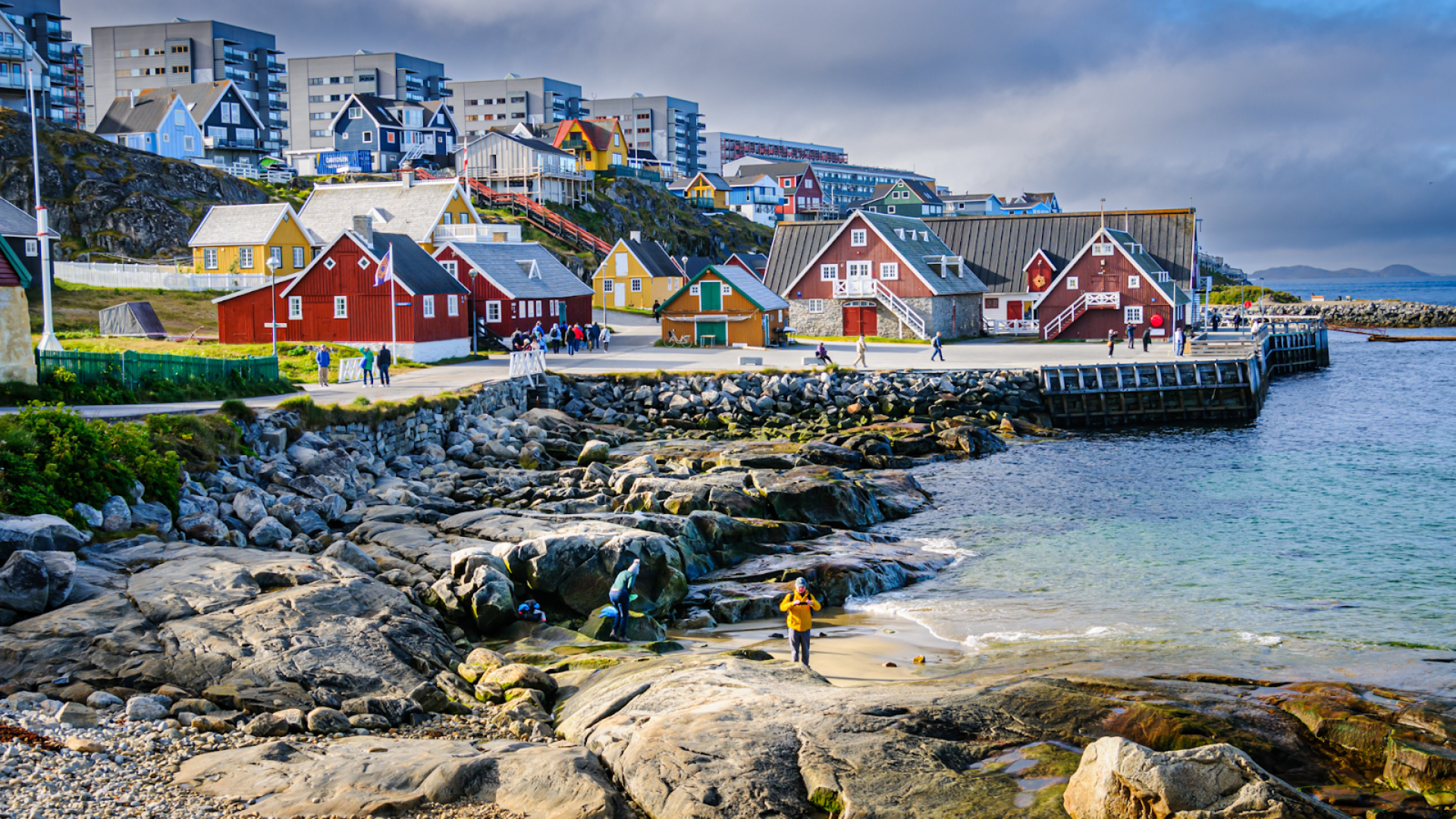
Nuuk, the capital and largest settlement, sits beneath the mountains, its colourful houses lining the shoreline. The city combines modern life with Greenlandic heritage. It’s here you’ll find museums, cultural centres and a lively local community which stand alongside cafés, restaurants, and a growing arts scene. If you have the chance, Myggedalen Panoramic View is fantastic to witness stunning vistas of fjords and peaks, while the Greenland National Museum and Archives shares the story of the land and its people, including the unforgettable Qilakitsoq mummies.
Further north, Ilulissat is dominated by the Icefjord, a UNESCO World Heritage site. Majestic icebergs drift toward the sea, their surfaces constantly cracking and shifting. Hiking routes and boardwalks along the fjord offer opportunities to take in the bay and view the ice from different angles, while the town itself is charming, with brightly coloured houses climbing the hills, cafés serving local dishes, and a small museum celebrating explorer Knud Rasmussen.
.png)
There’s nothing quite like Greenland. You can stand on the deck of a ship or a trail, and it’s the scale that hits you. Enormous fjords, drifting ice, tiny settlements. Wildlife appears when it chooses, and the light is always shifting in brilliant displays that keep you wanting to brave the cold and stay outside. Even seasoned travellers find themselves drawn back by its grand beauty. No matter how you choose to experience it, the only thing you need to do is go.
Feature image: iStock/KenWiedemann
Tell us in the comments below: Have you ever been to Greenland? What was your highlight?

Keep travelling: